| Period | 1995–2004 |
| Description | The corporate, educational aesthetic of the early digital era, defined by globe motifs, primary colors, and high-tech campus optimism. |
| Categories | Aesthetics_Wiki_Articles, Design_Aesthetics, 1980s, 1990s, 2000s, Science |
Utopian Scholastic
What is it?
Utopian Scholastic (also known as Global Village Coffeehouse's academic cousin) is a prevalent design aesthetic from the late 1980s to the early 2000s. It represents the visual identity of edutainment media—think encyclopedias, nature documentaries, and science museum exhibits. It is characterized by a "polished" educational look that sought to make the information age feel sophisticated and global.
Visually, it is defined by high-contrast photo collages set against minimalist white backgrounds. It often features motifs of "enlightenment": ancient history (Egypt, Greece), natural phenomena (dinosaurs, space), and early digital globe iconography. It is the visual equivalent of an expensive educational CD-ROM from 1997.
History & Origins
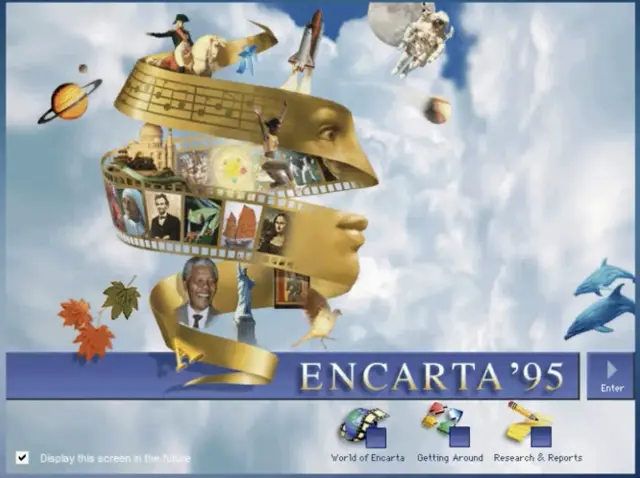
The "Microsoft Encarta" Era
The aesthetic was most prominent in the branding of Dorling Kindersley (DK) books and early digital encyclopedias like Microsoft Encarta. These publications utilized a specific "cut-out" photography style on clean white pages, designed to make learning feel accessible yet authoritative. This was the era where home computers first became powerful enough to display high-resolution images, leading to a focus on rich, photographic textures.
Kid Version of Frasurbane
Often described as the "childhood version of Frasurbane," Utopian Scholastic brought a similar level of mid-century modern influence and classical appreciation to educational spaces. It reflected a period of intense global optimism where the internet and new media were seen as tools that would unify human knowledge and create a "Global Village."
The look: a field guide
Photo Cut-outs on White
A signature minimalist layout style. High-resolution photographs (dinosaurs, planets, artifacts) are cut out from their backgrounds and placed on stark white canvases.
Serif Typography
A heavy reliance on elegant, traditional serif fonts—primarily Times New Roman or Adobe Garamond—to evoke a sense of academic authority and timelessness.
Global & Scientific Motifs
Frequent use of transparency, glass spheres, globes, and diagrams of atoms or ancient ruins, symbolizing the breadth of human discovery.
Chromatic Primary Accents
While the backgrounds are minimalist, the imagery itself is often highly saturated and colorful, featuring the rich, glossy textures of late 90s CGI and photography.
Quick-reference checklist
- Does it look like the inner pages of a 1990s DK Eyewitness book?
- Is there a photo of a planet or a dinosaur cutout on a white background?
- Are the fonts primarily classic serifs like Times New Roman?
- Does the environment feel educational, optimistic, and corporate?
- Is there a focus on ancient history, nature, or space science?
Gallery
Click any image to enlarge. Images load on demand.