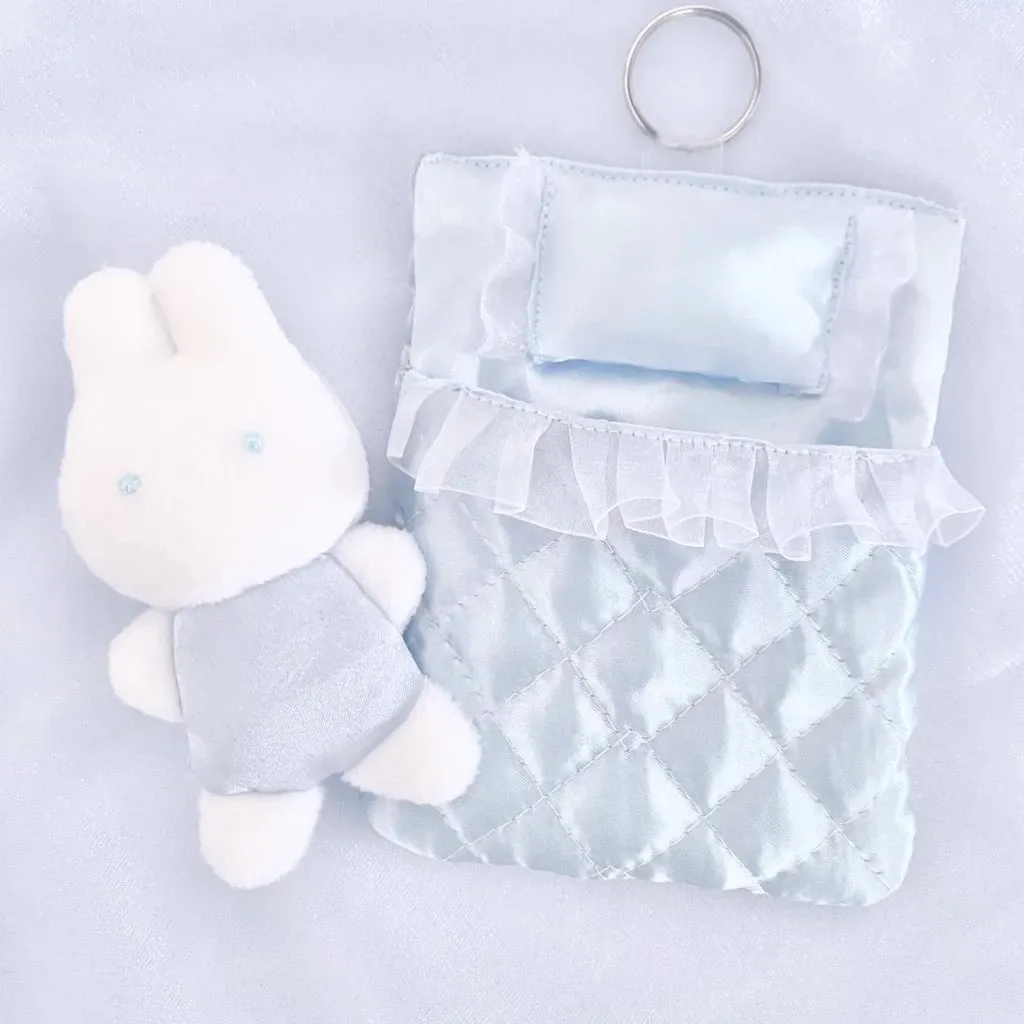
| Japanese | 水色 (water-colored) |
| Also known as | Tenshi Kaiwai (incorrect Western term) |
| Period | Mid-2010s – present |
| Peak | 2020 (tracksuit revival) |
| Origin | Japan (internet / idol culture) |
| Origin figure | Ano (You’ll Melt More!) |
| Key palette | Light blue, white, silver, blush pink |
| Key tags | 水色界障, 水色サブカル |
Mizuiro
What is it?
It’s 2:00 in the afternoon somewhere in Tokyo and the sky looks like it always does in these photos , not grey, not blue, but that exact in-between that Japanese has a word for: mizuiro. Water-colored. You’re wearing a light blue tracksuit with a Cinnamoroll keychain dangling from your bag. Your makeup is mostly blush , a lot of blush , and your gaming setup at home is organized around the same color palette as your outfit, because of course it is. You have a figure of Rei Ayanami on your shelf. You found it at an arcade.
That’s Mizuiro. And if you’ve spent more than ten minutes on the Japanese internet circa 2020–2023, you have definitely encountered it, possibly without realizing it had a name.
Mizuiro (水色) translates most literally as “water colored,” though “aqua” or “light blue” does the job for anyone who doesn’t have that particular sky-and-concrete shade filed somewhere in their brain. It’s a Japanese aesthetic that emerged properly in the mid-to-late 2010s and peaked again in 2020, built around a very specific palette , light blue, white, silver, the occasional blush pink bleeding in from a kawaii mascot , and a mood that sits somewhere between nostalgic and quietly pessimistic. It’s otaku culture done with intention. It’s cute, but it’s not trying to cheer you up.
The name problem (a brief but necessary detour)
If you’ve spent time on Western corners of the internet, you may have heard people call this “Tenshi Kaiwai” , or, if they got a bit confused, “Tenshi Kawaii.” Neither is correct, and the Japanese community would like everyone to know this.
Tenshi Zyoshi (川使界障) is a magazine and blog that featured this aesthetic heavily during its 2020 revival. 川使界障 is its community hashtag. It is not the name of the aesthetic. The aesthetic is Mizuiro. The confusion is understandable , the blog did more than almost anything else to popularize the look , but calling Mizuiro “Tenshi Kaiwai” is a bit like calling every Gen X Soft Club mood board “Wallpaper* Magazine.” The map is not the territory.
If you want to find actual Mizuiro content from the source, the relevant Japanese-language tags are 水色界障 (mizuiro community), 水色サブカル (mizuiro subculture), and 水色韭團気 (mizuiro aesthetic). These will not disappoint.
History
Before Mizuiro had a name or a community, it had a person: Ano, the “light blue” member of the Japanese idol group You’ll Melt More!, who spent the mid-to-late 2010s being extremely herself , a self-described social outcast in customized light blue tracksuits, doing her own strange, slightly melancholy thing while her bandmates did theirs. Her fans picked up the visual language. It spread. The vibe had always existed; she gave it a face and a color.
The aesthetic’s second wind came in 2020, riding what can only be described as a tracksuit boom. Which sounds absurd until you picture it, and then it makes complete sense. Tracksuits as art direction. Tracksuits as a statement. Mizuiro was ready.
Visuals
Everything in Mizuiro has been processed , cooled down, tilted toward blue-grey, given a slight haze. If a photo looks like it was taken through a light frosted glass, or through the window of a train during light rain, it’s probably in the right neighborhood.
The palette runs on light blue and white as its non-negotiables, with black and silver filling the gaps. Pink shows up because blush makeup is practically a uniform in this aesthetic, and because kawaii merchandise is unavoidably pink in places. The look is cold without being clinical, cute without being loud.
Many Mizuiro images have a distinctly retro-digital quality , Web 1.0 interfaces, old-school low-poly computer graphics, the visual language of early internet and Y2K-era tech. This flavor of nostalgia , not for childhood innocence but for a specific moment in digital culture, around the late ’90s through early 2010s , sits very comfortably alongside the cool-toned palette and the otaku-inflected world of arcades and desktop gaming setups.
The illustrations are a world unto themselves: wobbly, minimalistic, slightly unpolished in a way that is absolutely intentional. Wabi-sabi as character design. The characters these images feature are rarely story-driven , they exist for the look, the color, the feeling. Except when they’re pulling from established franchises, at which point Rei Ayanami, Cinnamoroll, Hachiware from Chiikawa, and Sanrio’s Hangyodon do most of the heavy lifting. What they have in common: predominantly white and blue. The color scheme is load-bearing.
Fashion
Classic Mizuiro (2010s era)
Tracksuits and leg warmers and light blue everything, with kawaii patches and a general softness underneath what was technically sportswear. The whole thing was slightly contradictory in a way that worked , tough-ish fabric, delicate imagery, a color palette associated with both winter sky and baby clothes.
The athletic thread is important. Mizuiro fashion isn’t trying to be elegant. It’s comfortable, slightly slouchy, the kind of outfit you’d wear to an arcade or a walk to the convenience store , which are, as it happens, exactly the kinds of places where Mizuiro photos get taken.
The locations
This is an aesthetic with a very specific geography. Arcades. Gaming setups. City streets with concrete and steel in the background. Parking garages with fluorescent lighting doing something interesting to blue. The industrial edges of urban Japan, which happen to photograph beautifully against a light blue color story.
Music
Mizuiro’s playlist skews electronic and VOCALOID-adjacent. Koresupe and xea are the go-to artists. Canonical songs include “Aqua Illumination” by Pedestrian feat. Hatsune Miku, “Light Blue Invasion” by Nayutalien, “Mizuiro Paralyze” by Munen, and “Dennou Mienmin Mao” by namigroove feat. KAFU.
On TikTok, the standard format is: light blue outfit, fast-paced electronic or VOCALOID track, face partially obscured by stickers or filters. The obscured face isn’t incidental , it fits the aesthetic’s relationship with privacy, distance, and a certain deliberate blurring of identity.
- Light blue, white, or silver as the dominant palette?
- Cool, slightly hazy photo processing?
- Retro-digital or Y2K-era tech imagery?
- Kawaii mascots or VOCALOID characters (especially Cinnamoroll, Rei Ayanami)?
- Wobbly, minimalistic illustration style?
- Tracksuit or athletic wear in pastel blue?
- Arcade, gaming setup, or urban concrete in the background?
- Overall vibe: “cute but not trying to cheer you up”?
Four or more? Put on some Nayutalien. Add excessive blush. You’re most of the way there.
See also
- Frutiger Aero , shares the aqua-and-blue palette
- Liminal Space , shares the transitional urban settings
- Y2K Futurism , shared retro-digital nostalgia
Gallery
Click any image to enlarge. Images load on demand.