| Period | 1990s–2004 |
| Description | The primordial digital era for the internet, defined by raw HTML, animated GIFs, construction banners, and a total lack of corporate polish. |
| Categories | Aesthetics_Wiki_Articles, Internet_Culture, 1990s, 2000s, Retro |
Old Web
What is it?
Old Web (also known as Web 1.0, GeoCities Aesthetic, or 1990s Web Design) is a visual style that romanticizes the graphic design and chaotic functionalism of the World Wide Web during its first mainstream era in the 1990s and early 2000s. rather than being a curated or intentional style, it was the organic outcome of technological limitations meeting massive amateur creativity.
Visually, it is an era defined by raw technical constraints. It celebrates a time before centralized, corporate social media platforms existed, when the internet was primarily a space for individual, decentralized expression and highly personalized "homepages."
History & Origins
The Personal Homepage Era (1994–1999)
Services like GeoCities, Angelfire, and Tripod provided free tools that allowed millions to "homestead" a piece of the internet. The look and feel were directly shaped by slow dial-up internet speeds, which required small, highly compressed images, leading to the absolute dominance of the GIF format.
A Culture of Wild West Creativity
Because early versions of HTML offered extremely limited styling options, creators were forced
to rely on rigid, grid-like layouts strictly built using <table> tags and frames.
Furthermore, monitors of the era could often only display a limited 256-color palette, leading to the strict
use of high-contrast "web-safe" colors to ensure consistency across different operating systems. This
promoted a "Wild West" culture of vibrant, maximally chaotic creativity.
The look: a field guide
Tiled Desktop Backgrounds
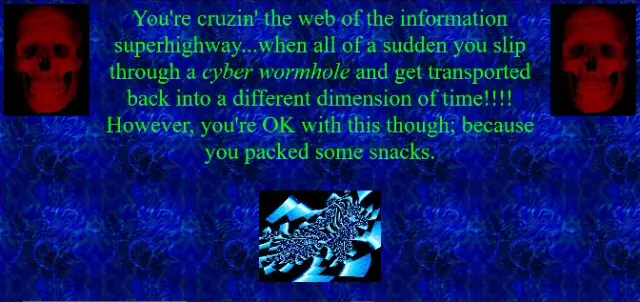
Because large images took too long to load, the primary way to decorate a page was using tiny, low-res patterns (stars, marble, or repeating textures) that tiled infinitely across the screen.
Animated GIFs & "Construction"
Maximalist use of animated elements. The most iconic is the spinning "Under Construction" barricade or yellow tape, constantly excusing the broken nature of the website.
Visible Tables & Web-Safe Colors
Rigid, visible HTML frames dividing the content. Text was usually neon green or bright yellow over deep black backgrounds, adhering to the 256 "web-safe" color gamut.
Community Artifacts
The proud display of physical web community tools, principally the neon LCD-style "Visitor Counter" and a link to officially "Sign the Guestbook."
Quick-reference checklist
- Is there a prominent, animated "Under Construction" banner?
- Does the background pattern tile infinitely to save bandwidth?
- Are there visible HTML frames or tables holding the layout together?
- Are the colors constrained to high-contrast, vibrantly glowing "web-safe" hues?
- Is there an odometer-style visitor counter or a guestbook?
Gallery
Click any image to enlarge. Images load on demand.