| Also known as | Old CGI, Retro CGI |
| Period | Mid-1980s – Early 2000s |
| Peak | 1990s |
| Origin | Professional CGI studios, Silicon Graphics Inc. |
| Named by | Karl Kraft / CARI |
| Key traits | Sparse polygons, alien landscapes, chrome surfaces, gradient skies |
| Successor | Photorealistic CGI, Y2K Futurism |
Silicon Dreams
What is it?
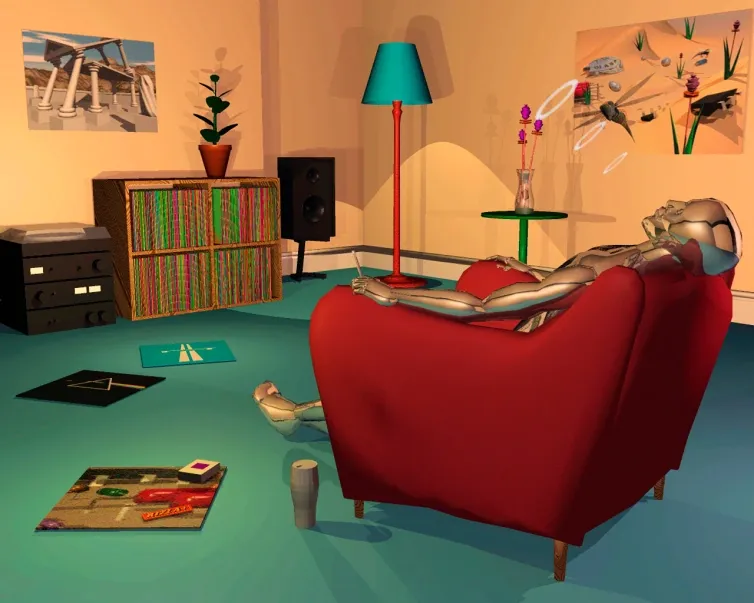
Picture a landscape that has no name. It’s a barren, smooth plane stretching to the horizon under a sky that’s just a gradient , dark at the top, lighter at the bottom. There might be a large ringed planet hanging improbably close, its sphere rendered with a few hundred polygons, its rings perfectly flat. There are some floating spheres. Maybe a chrome torus slowly rotating for no particular reason. The lighting is harsh and comes from one direction. The shadows are too crisp. The textures look like someone wrapped a JPEG around a slightly rounded rectangle.
It’s beautiful. It’s deeply strange. And it’s recognizable to anyone who spent time near a computer between about 1985 and 2002, because it was everywhere: on TV bumpers, in advertising, on CD covers of children’s software, in the boot animations of operating systems, in the cutscenes of early video games.
That’s Silicon Dreams , the surreal, uncanny, and strangely beautiful aesthetic of early computer-generated imagery from the mid-1980s through the early 2000s, before CGI learned to be photorealistic and stopped being interesting. The name comes from the Silicon Dreams Facebook group run by Karl Kraft, assembled years before the broader internet caught on, and also nods toward Silicon Graphics Incorporated (SGI) , the company that made the workstations responsible for much of the era’s most iconic imagery.
The name: Silicon Graphics and the machines behind the dreams
Silicon Graphics Incorporated, founded in 1982, made the most powerful 3D graphics workstations of the era. An SGI workstation in the late 1980s or early 1990s cost anywhere from $10,000 to $250,000. These were not home computers , they lived in production studios, university research labs, and military contractors.
This scarcity had an enormous effect on what got made. Every polygon, every texture, every render pass had a cost. When you can only afford sparse geometry and simple textures, you don’t fill your frames with detail. You make compositions of floating objects against pure backgrounds. You let the mathematical beauty of smooth surfaces and clean shadows speak for itself. And you create something that doesn’t look like the real world , because making it look like the real world was impossible, and trying would only expose the limitations. Instead, Silicon Dreams imagery looks like a different world entirely: cleaner, stranger, more geometric.
History: from university labs to Trapper Keepers
First sparks (1960s–1970s)
CGI’s roots go back to the late 1950s and 1960s, when researchers at MIT were experimenting with using computers to generate visual output at all. Ivan Sutherland’s Sketchpad system (1963) is often cited as the first interactive computer graphics program. The 1970s brought the first tentative steps toward 3D: the “Computer Animated Hand” (1972), created by Ed Catmull (later a founder of Pixar) at the University of Utah, is considered the first 3D computer animation ever made.
The 1980s: the aesthetic crystallizes
The early-to-mid 1980s are where Silicon Dreams as a recognizable aesthetic really begins. Silicon Graphics shipped its first workstations in 1982. Pixar was founded in 1986. ILM was doing CGI work for major films. And TV advertising began incorporating CGI because it looked futuristic in a way that practical effects couldn’t match.
The demo reel culture of the era deserves special mention. Studios like Pacific Data Images and Robert Abel & Associates produced annual demo reels , showcases intended to attract clients. These reels are essentially Silicon Dreams compilations: floating objects, abstract landscapes, technical demonstrations of software capability.
The 1990s: mainstream arrival and the golden age
The watershed moment was Toy Story (1995). Pixar’s first feature-length CGI film proved that computer animation could carry a major commercial release , and showed the limitations in the most charming way: the human characters look slightly eerie, the textures simplified, Woody’s face carrying that specific uncanny quality that became the decade’s defining characteristic.
But Toy Story was the high end. Across the decade, Silicon Dreams was appearing everywhere:
- Television bumpers , the chrome spinning logos of network TV in the early 1990s
- Advertising , cars floating in space, products rendered in chrome against pure white
- Video games , the blocky-yet-majestic landscapes of Super Mario 64, the pre-rendered backgrounds of Final Fantasy VII, the alien corridors of Doom and Myst
- Trapper Keepers , the Mead ring-binder organizer carried by every American student, delivering Silicon Dreams imagery to millions of school desks
- Bryce 3D , the landscape rendering software that let anyone with a PC generate Silicon Dreams vistas
The look: a field guide
Sparse geometry
There are never enough polygons. Objects have angular silhouettes, curved surfaces are approximated by flat-sided polyhedra, and if you look closely at a sphere, you can count the segments. This is not a bug , it’s the aesthetic.
Alien landscapes
Mountains too perfectly triangular, valleys with no organic irregularity, plains extending too flatly. Silicon Dreams environments look like mathematical functions translated into terrain , which is often exactly what they are.
Large celestial objects
Enormous planets, moons, or ringed bodies hanging in the sky, often taking up a quarter of the frame. Aesthetically perfect , big, smooth, quietly spectacular. Catastrophically close in reality.
Chrome and metallic surfaces
The reflective chrome sphere is possibly the single most iconic Silicon Dreams object. Technically demonstrative (we can do reflections!) and visually striking. Chrome tori, cylinders, blobs , all present throughout the era.
Gradient skies
Backgrounds are rarely complex , typically a simple gradient from one color to another, or a solid color. This gives compositions a clean, abstract quality that feels simultaneously minimal and otherworldly.
The uncanny valley
When Silicon Dreams imagery tried to render anything organic , a human face, an animal, a plant , it produced results simultaneously recognizable and deeply wrong. This uncanny quality is now one of the aesthetic’s most prized characteristics.
Checked and grid patterns
The classic infinite checkered plane, extending to the horizon, was a staple of both technical demonstrations and aesthetic compositions. It showed that a surface existed without requiring any complex texture.
Bold, saturated colors
Electric blues, magentas, neon greens, deep purples , colors that nature doesn’t offer. Partly technological (early rendering handled saturated colors better than subtle ones) and partly aesthetic preference.
The technology behind the dreams
The hardware used varied enormously:
- Professional end: Silicon Graphics Iris and Indigo workstations, running Alias (later Alias|Wavefront, then Maya) and Softimage. Pixar’s own RenderMan software. Tens of thousands of dollars.
- Semi-professional: High-end Macintosh computers running 3D Studio or Electric Image. Amiga computers, which had exceptional graphics capabilities for their price , widely used by small studios.
- Consumer end: By the mid-1990s, Bryce, Ray Dream Designer, and Caligari TrueSpace made 3D rendering accessible to anyone with a reasonably capable PC.
- Gaming hardware: The SNES’s Mode 7 scaling, the Nintendo 64’s polygon rendering, the PlayStation’s notoriously wobbly textures , each created its own Silicon Dreams aesthetic through real-time 3D.
Key works: a canon
Film
- TRON (1982)
- The Mind’s Eye series (1990–1996)
- Toy Story (1995)
- Antz (1998)
- A Bug’s Life (1998)
Television
- ReBoot (1994–2001)
- Beast Wars: Transformers (1996–1999)
- VeggieTales (1993–present)
- The Simpsons “Homer³” (1995)
Video games
- Myst (1993)
- Star Fox (1993)
- Donkey Kong Country (1994–1996)
- Super Mario 64 (1996)
- Final Fantasy VII (1997)
- LSD: Dream Emulator (1998)
The music connection
Silicon Dreams had a natural sonic companion in the new age and ambient electronic music of the era. If you were watching a Silicon Dreams animation in the early 1990s, the soundtrack was probably synthesizer-heavy, slightly new-agey, and optimistic-futuristic in a vague sort of way.
The Mind’s Eye compilation films used ambient and new age compositions that became inseparable from the visual aesthetic. In the late 1990s and early 2000s, “intelligent” drum and bass (LTJ Bukem, Goldie, the Good Looking Records scene) adopted Silicon Dreams imagery for album covers and music videos. When Vaporwave emerged in the early 2010s, it explicitly incorporated Silicon Dreams visual elements as part of its nostalgic collage.
Decline and revival
Silicon Dreams faded from mainstream use around 2002–2005 for a simple reason: CGI got good enough to be invisible. The goal of much professional CGI had always been photorealism , the ability to make digital images audiences couldn’t distinguish from live action. By the mid-2000s, that goal was achievable. And once it was achievable, it became the standard. The aesthetic baggage of early CGI became marks of technical inadequacy rather than visual style.
The internet revival came in two waves. Seapunk in the early 2010s was explicitly Silicon Dreams-influenced. Vaporwave followed and deepened the connection. By the mid-2010s, there was a dedicated online community specifically for Silicon Dreams imagery. The revival resonates for the same reason all aesthetic revivals resonate: the imagery is tied to specific memories and to a particular cultural moment , the time when computers were new enough to be magical.
Quick-reference checklist: is it Silicon Dreams?
- Sparse polygonal geometry with visible faceting?
- Alien or abstract landscapes with no organic irregularity?
- Large planets or celestial bodies in the background?
- Chrome, metallic, or perfectly smooth reflective surfaces?
- Bold, saturated colors that don’t appear in nature?
- Gradient skies with no clouds or atmospheric detail?
- Textures that look hand-painted and stretched over a shape?
- Overall vibe: “this is what a computer thinks a world looks like”?
Four or more? You’ve got a Silicon Dream. The future looked exactly like this, briefly, and it was wonderful.
See also
- Frutiger Aero , successor aesthetic
- Signalwave , related music aesthetic
- Vaporwave , major revival context
- CARI , Silicon Dreams
Gallery
Click any image to enlarge. Images load on demand.