| Period | Late 1990s–mid 2000s (Harajuku) |
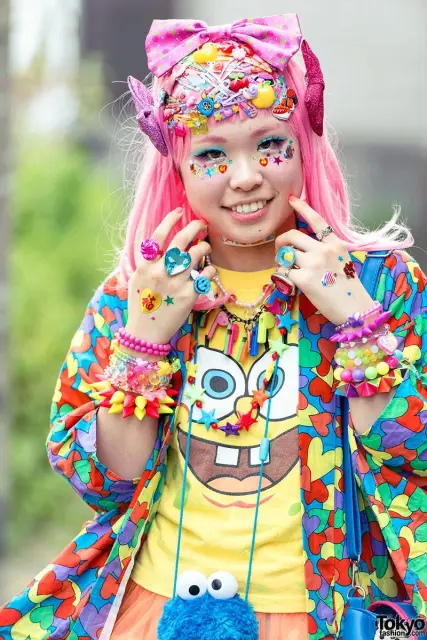
| Description | A maximalist Japanese street fashion aesthetic defined by layering excessive amounts of colorful accessories and toys. |
| Categories | Needs_work, Aesthetics_Wiki_Articles, Fashion, 2000s, Japanese, Feminine |
Decora
What is it?
Decora (from the Japanese word for "decoration") is one of the most iconic subcultures to emerge from Tokyo's Harajuku district. It is a radical rejection of minimalism, embracing a "toy-box" aesthetic where more is always better.
Visually, Decora is a chaotic, multi-layered explosion of neon colors. It is most famous for its "accessory mask"—the practice of wearing dozens of hair clips on the bangs, multiple necklaces, and layers of colorful band-aids across the face.
History & Origins
The FRUiTS Magazine Era (1997)
The aesthetic was popularized by photographers like Shoichi Aoki, who documented the unique street styles of Harajuku in FRUiTS magazine. Decora was the visual rebellion of Japanese youth who wanted to express their childhood joy in a society that valued adult conformity.
The MySpace/Tumblr Spread
Decora became a global phenomenon as photos from Harajuku were shared on early internet forums. It heavily influenced the "Scene" and "Kidcore" aesthetics, providing the blueprint for the use of "kandi" jewelry and clashing primary colors as a badge of alternative identity.
The look: a field guide
Accessory Saturation
Wearing so many hair clips, bracelets, and rings that the original hair color or skin is barely visible through the plastic.
Clashing Pattern Layers
Pairing polka dots with stripes, leopard print with stars, and wearing multiple pairs of neon-colored socks at once.
Face Decoration
Decorative stickers and patterned medical band-aids worn on the bridge of the nose as a fashion statement.
Cartoon Plush-ware
Carrying stuffed animals or wearing character-branded backpacks (Hello Kitty, Pikachu) as functional fashion.
Quick-reference checklist
- Are there more than 10 hair clips visible in the person's hair?
- Is the color palette a "rainbow" of neon primary and secondary colors?
- Are there multiple layers of patterned socks or leggings?
- Do you see band-aids on the face or stickers on the skin?
- Is the image from a 2002 Harajuku street-photography magazine?
Gallery
Click any image to enlarge. Images load on demand.