| Period | 2014 – present |
| Origin | Tumblr (coined 2014) |
| Coined by | on-a-crescendo (Tumblr) |
| Key texts | The X-Files, Gravity Falls, Twin Peaks |
| Key cryptids | Mothman, Bigfoot, Jersey Devil, Slenderman |
| Key palette | Earthy browns, forest greens, low-light photography |
| Fashion | Flannel, Converse, cargo pants, enamel pins |
Cryptidcore
What is it?
It’s a Tuesday night somewhere in rural America. You are at a Denny’s. You have a binder. The binder contains printed-out forum posts, hand-annotated satellite images, a photocopy of a 1979 newspaper article about a series of sightings near a reservoir, and a to-do list that includes “check tide charts re: Chessie,” “return library book on ley lines,” and “find out if the Loveland Frog Man is still active.” You are wearing a flannel shirt. Your Converse are well-worn. There is a Mothman pin on your backpack that you bought from a highway gift shop somewhere in West Virginia, alongside a keychain shaped like a UFO and a kitschy t-shirt that says AREA 51: WHAT ARE THEY HIDING.
You are not embarrassed about any of this. In fact, you are having the time of your life.
That’s Cryptidcore. It’s the aesthetic of the paranoid, the curious, and the fundamentally delighted , people who find the world more interesting when something unknowable might be lurking at the edge of the treeline, and who have organized their wardrobe, their media diet, and their hobby time accordingly.
The emotional logic
Most aesthetics are built around a feeling: nostalgia, melancholy, wonder, unease. Cryptidcore is built around something slightly different, which is the pleasure of being in on a mystery. Not the solved kind , not the murder mystery where you figure it out by chapter fourteen. The ongoing kind. The kind where the evidence is ambiguous and the community is passionate and the thing itself, whatever it is, keeps not quite showing up on camera.
There are two flavors of Cryptidcore enthusiast, and most people are some mix of both. The first wants to be the investigator: the one with the binder, the field journal, the red string connecting the photographs on the board. This is the X-Files energy, the Gravity Falls energy , a team of people who care too much, organized around a mystery they probably won’t solve and couldn’t stop pursuing even if they tried. The second wants to be the cryptid: the thing that exists at the edge of what anyone can verify, strange enough to have an entry on a wiki, real enough to have witnesses, free enough to remain unconfirmed.
History
The visual and cultural DNA of Cryptidcore is old , it runs through 1970s paperback occult books and tabloid front pages, through the kind of low-budget television that aired at 11pm. Kolchak: The Night Stalker (1974–75) is one of the founding texts: a reporter investigating supernatural events in environments that were already liminal before liminal had a name , night-shrouded forests, sewers, suburban streets after dark.
From Kolchak came a lineage running through Twin Peaks (1990), The X-Files (1993), and into the internet age. What the internet did , specifically what Tumblr did in the early 2010s , was give the fans of all these aesthetically adjacent works a place to compare notes. The moodboard was born. And the fans of Gravity Falls, The X-Files, Welcome to Night Vale, and Twin Peaks realized, looking at each other’s boards, that they were all describing the same world.
The word “Cryptidcore” was coined on Tumblr in 2014, in a post by user on-a-crescendo that assembled the elements: the kitschy souvenir shop t-shirts, the tin foil hats, the muffled X-Files theme playing in the distance. The Regional Gothic trend on Tumblr in 2015 added visual texture , the forests, the diners at night, the sense that the ordinary American interior landscape contains something the tourist brochures are not mentioning.
The visual language
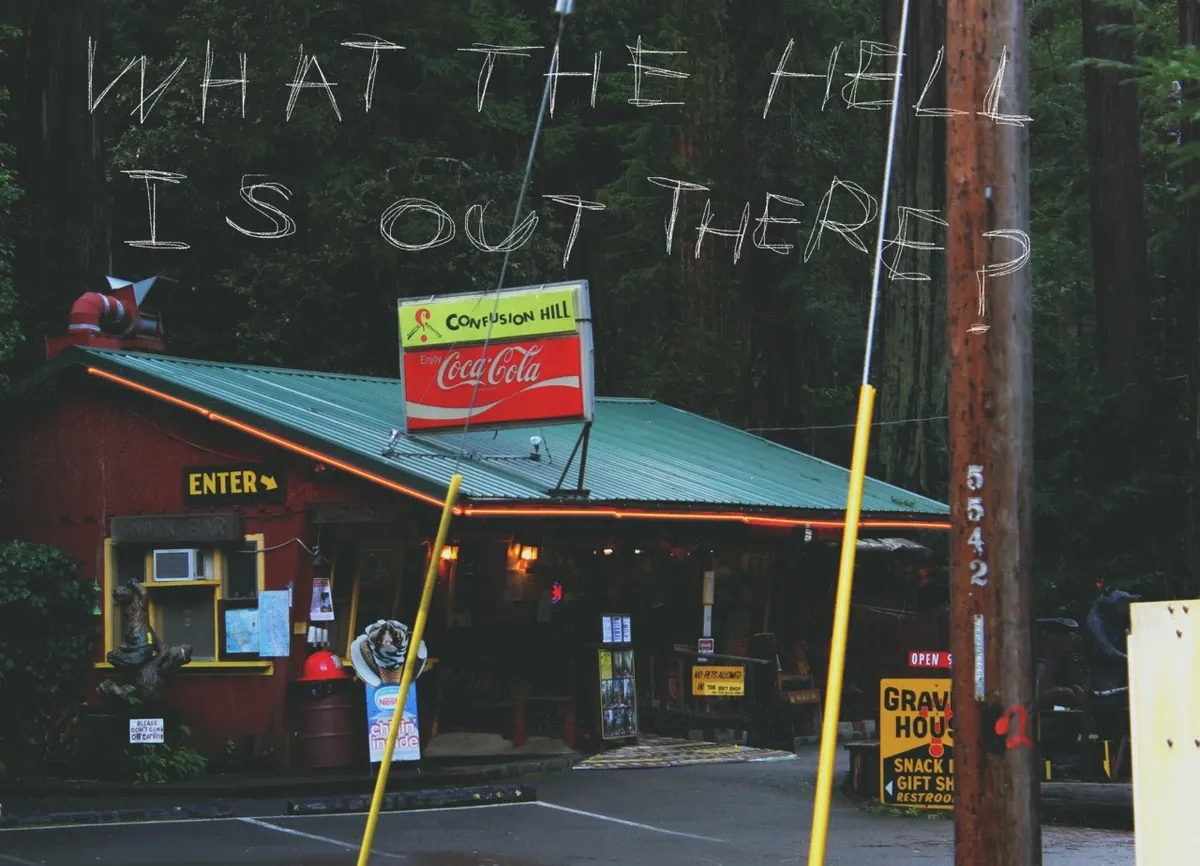
The world of Cryptidcore is the landscape of American folklore filtered through VHS-era entertainment: dark forests, roads that go somewhere uncertain, small towns that feel like they’re hiding something, diners open at 2am for no particular reason. Old newspapers. Polaroid photographs , the format implies an analog past, a time when the evidence of a sighting was physical and limited. Field diaries. Glow-in-the-dark imagery. Alien iconography. The specific visual culture of supernatural tourist traps that developed around every significant cryptid sighting location.
The visual palette is earthy: browns, beiges, the greens of actual forests rather than the idealized green of more optimistic aesthetics. Low-light photography. The blur and grain of low-resolution evidence.
Fashion
Cryptidcore fashion is the wardrobe of someone who might need to go investigate something at any point and wants to be dressed for it. Comfortable. Practical. Slightly weathered.
- Graphic tees , especially the kitschy cryptid-themed ones from roadside shops
- Flannel shirts , the default outer layer
- Corduroy jackets, cargo pants with the pockets actually used
- Doc Martens or worn Converse
- Hoodies with patches ironed on
- Backpacks loaded with at least three things that have no obvious immediate purpose
- Lanyards. Earthy tones throughout.
Iron-on patches are worth highlighting: they’re the Cryptidcore equivalent of vinyl stickers on a laptop, a way of marking your affiliations and interests on the textile surface of your actual clothing. The well-curated Cryptidcore jacket patch collection tells a story.
The cryptids themselves
Mothman
Probably the most beloved, for reasons that go beyond pure fear and into genuine affection. The Mothman has a very active fan community and at least one town in West Virginia that has fully leaned into it economically.
Bigfoot
The classic, the granddaddy of American cryptids. Sightings reported across the Pacific Northwest, making it one of the most geographically widespread entries in the canon.
The Jersey Devil
A winged creature said to inhabit the Pine Barrens of New Jersey. One of the oldest continuously reported cryptids in American folklore.
Slenderman
The internet’s contribution to the cryptid tradition , born from a Photoshop contest in 2009, became one of the most significant pieces of internet folklore ever created.
Chupacabra
The “goat sucker” of Puerto Rican and Latin American folklore, later spreading to the American Southwest. Central to the aesthetic’s border-crossing mythology.
Local cryptids
The aesthetic specifically encourages research into regional cryptids: the Pacific Northwest Tree Octopus, the Fresno Nightwalkers, the Honey Island Swamp Monster, the Cactus Cat. The world is full of things that haven’t been verified yet.
The media canon
Television
- The X-Files (1993–2018) , primary text
- Twin Peaks (1990–1991, 2017) , the prestige wing
- Kolchak: The Night Stalker (1974–1975) , founding text
- Gravity Falls (2012–2016) , Gen Z entry point
- Stranger Things (2016–) , gateway for many
Podcasts and audio
- Welcome to Night Vale (2012–)
- Buzzfeed Unsolved (2016–) , YouTube pipeline
- Lore (2015–)
Music
The canon runs through Lemon Demon, Tally Hall, MGMT, Cavetown, and Mother Mother , acts whose work sits at the intersection of catchy and slightly unsettling, melodic and a bit strange. “Touch-Tone Telephone” by Lemon Demon is practically an anthem. “Little Dark Age” by MGMT. “Turn The Lights Off” by Tally Hall. Songs that sound like they know something.
Quick-reference checklist: is it Cryptidcore?
- Cryptid imagery or iconography (Mothman pins, Bigfoot tees, UFO keychains)?
- Earthy, low-light visual palette?
- Dark forests, rural roads, or small towns feeling slightly wrong?
- Old newspapers, Polaroids, or analog “evidence”?
- Flannel, corduroy, or worn Converse , comfortable and practical?
- Iron-on patches or enamel pins telling their own story?
- The X-Files, Gravity Falls, or Twin Peaks in the media diet?
- Overall vibe: “I have a binder and I’m not embarrassed about it”?
Four or more? The truth is out there. The flannel shirt is optional but recommended.
See also
- Liminal Space , shares the interest in strange, transitional environments
- Signalwave , shares the late-night TV texture
- Weirdcore , adjacent dream-logic aesthetic
- Dark Academia , related research-and-investigation energy
Gallery
Click any image to enlarge. Images load on demand.